

Case Studies
Bus Bridging Services
Bus Bridging Services
Study of optimal fleet composition in the event of
disruption to train services in Singapore
- Case Studies
- Holistic Transport System Evaluation & Exploration
- Bus Bridging Services
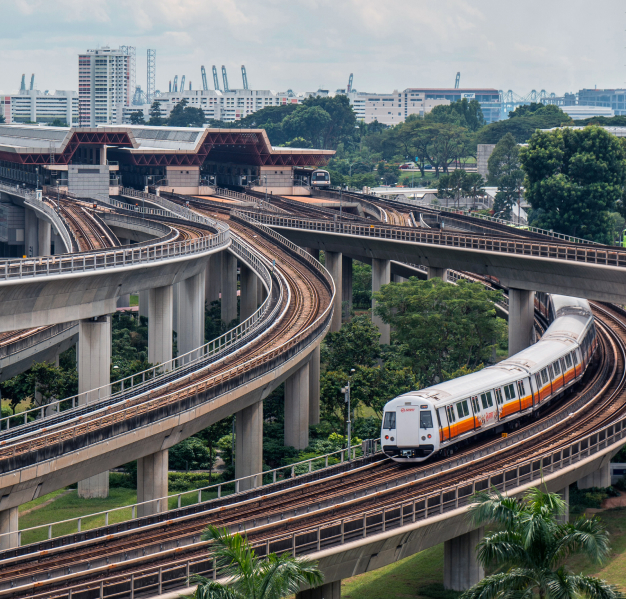
Combining Optimisation with CityMoS
In the domains of fleet management and transport planning, often numerical optimisation is used to find an optimal solution to a given complex problem. These problems commonly include the assignment of vehicles to tasks under given constraints, the optimisation of routes, as well as finding the minimum resources required to fulfil a list of given requirements. The scenario as well as the problem is formulated using mathematical equations which can then be solved using modern solvers such as CPLEX. For these optimisation problems to be manageable, they usually need to be simplified. Also, complex human behaviour and their interdependencies need to be expressed mathematically which also requires significant simplification, often to the extent where the validity of the obtained results can be questioned.The combination of optimisation with a realistic simulator to study the feasibility, validity and efficacy of a proposed solution, or, in the case of multi-objective optimisation, a pareto set, significantly increases the fidelity and trustworthiness of the entire approach. Insights gained with the simulation can be fed back into the optimisation model (e.g., assumed travel times of buses) and, where possible, new constraints can be included to avoid finding solutions that would only work in the mathematical representation of the real world, but not in the real world itself.
Case Study Singapore's MRT Network
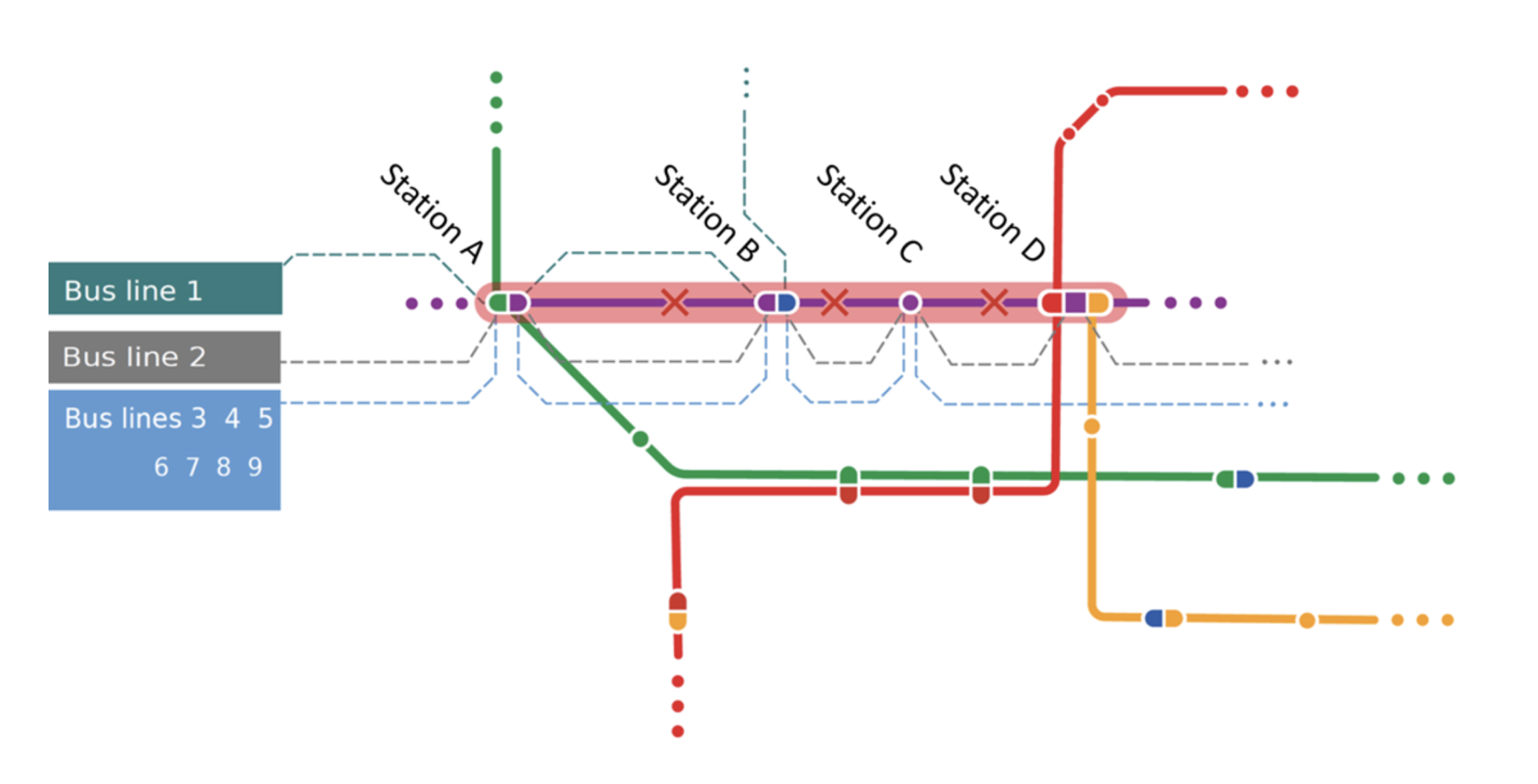 We studied a hypothetical disruption of an MRT line with the goal to use bus bridging services to transport all affected passengers either to the next non-affected MRT station or their destination. We considered existing bus lines along the affected corrido r as well as 7 specific bridging lines. Given a maximum number of twenty buses, we studied the optimal fleet composition (double decker buses, articulated buses, single decker buses) and their assignment to the bus bridging lines.
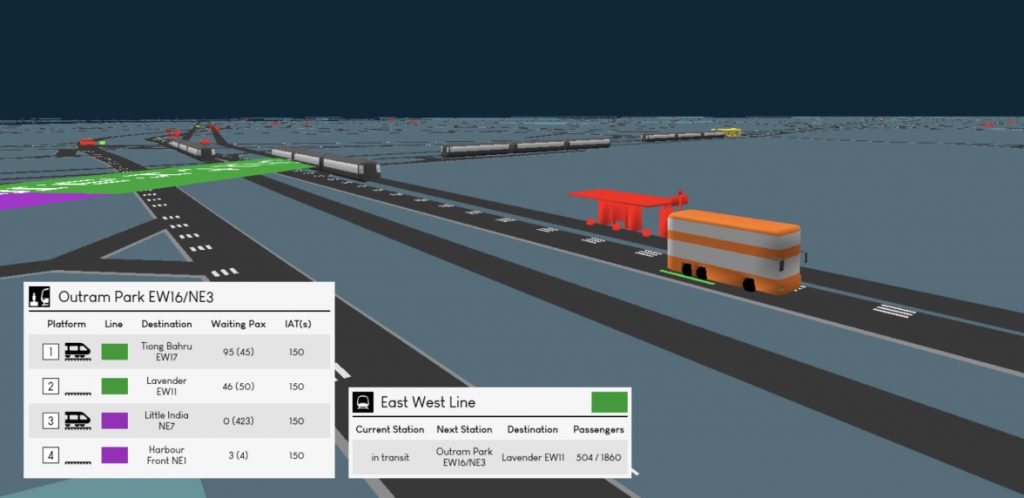
This problem was formulated as a mathematical optimisation problem which could be solved in a few minutes of computation. The target area was modelled in CityMoS and CityMoS was extended to be able to read the bridging bus plans generated by the solver. The simulation helped to significantly improve the optimisation formulisation and highlighted cases where the mathematical simplification of the real world led to underestimation of travel times as highlighted in the graph on the right.
More information on the topic can be found in these research papers:
- Iva Bojic, Chunling Luo, Xinrong Li, Daniel Zehe, David Eckhoff, and Carlo Ratti, “Optimal Railway Disruption Bridging Using Heterogeneous Bus Fleets,” IEEE Access, vol. 9, pp. 90656-90668, June 2021.
- Chunling Luo, Xinrong Li, Yuan Zhou, Aakil M. Caunhye, Umberto Alibrandi, Nazli Y. Aydin, Carlo Ratti, David Eckhoff, and Iva Bojic, “Data-driven disruption response planning for a Mass Rapid Transit system,” Proceedings of KES International Symposium on Smart Transportation Systems 2019 (KES-STS-19), St. Julians, Malta, June 2019, pp. 205-213.
In partnership with:

